Mounting without drilling: why BOMA Addflex makes the difference
There's a moment every facility manager knows. The walls have just been handed over, the tiles are perfectly laid, the room still smells new. And then someone walks in with a drill. From that moment on, the wall is no longer new. There are holes in it, dust on the floor, and a noise echoing down the corridor that nobody wants to hear. All to hang a soap dispenser. There's another way. With BOMA Addflex, dispensers stay firmly on the wall, with no drilling, no gluing and no sealant.
Drilling seems like a detail, until you add up the consequences
Mounting dispensers is rarely seen as a problem. But anyone who regularly fits out washrooms knows the downsides.
A drilled hole is permanent. If the dispenser ends up slightly too far from the sink, you can't simply move it. You drill again and are left with one or more holes to fill. On a tiled wall the risk is greater: a tile can crack or split, and a cracked tile isn't something you replace in a few minutes.
Drilling also makes a mess. Drill dust ends up on the floor, on the sink and in the grout. The room has to be closed off and taped up, and afterwards it needs cleaning.
Then there's the noise. A drill against a tiled wall can be heard throughout the building. In an office, that's annoying. In a care home, a hospital or a hotel, it's a real problem, because people live, recover or sleep there.
The alternatives are no better. A dispenser stuck on with silicone sealant is almost impossible to remove. Anyone who tries is left with adhesive residue and often damaged tiles.
What is BOMA Addflex?
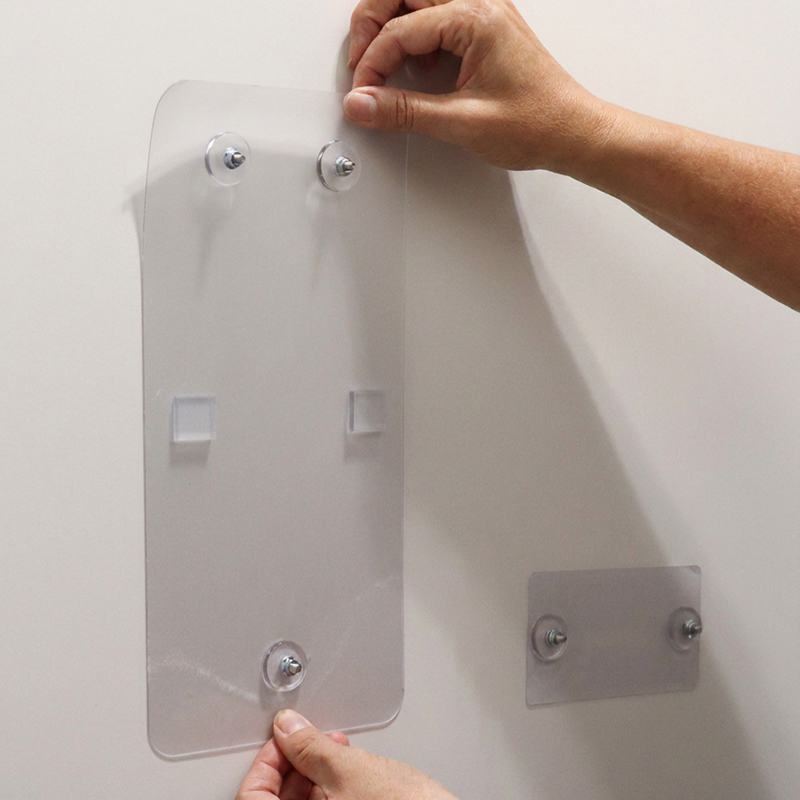
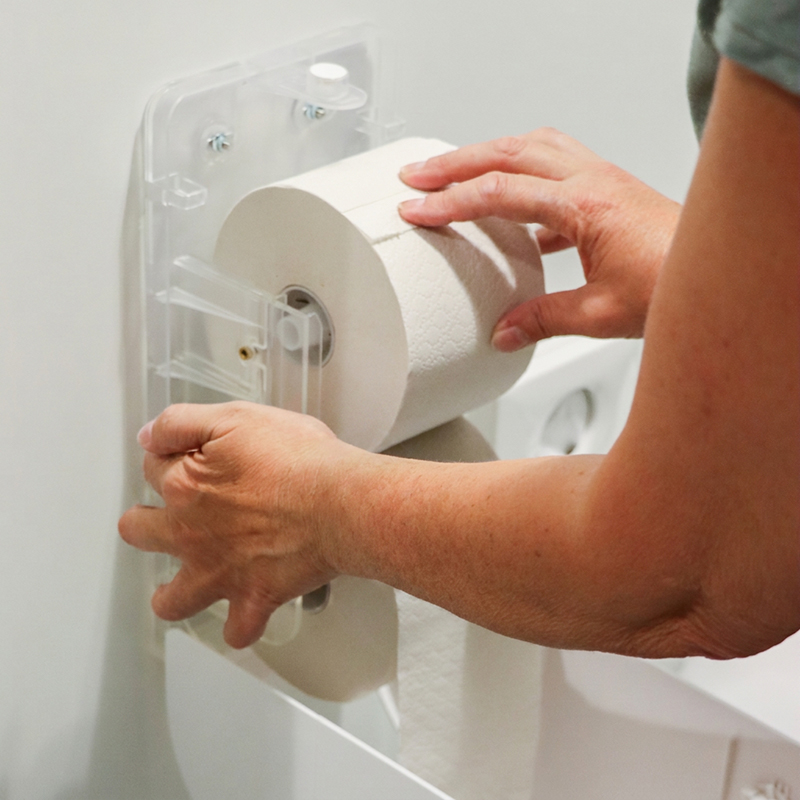
BOMA Addflex is a mounting system that uses 10,000 suction cups per cm² on a flexible pad. You clean the wall, peel off the film and press the pad onto the wall. The pad contains a threaded fitting that matches BOMA dispensers exactly. Screw the dispenser on, and you're done.
No drill. No wall plugs. No glue. No sealant. And not a single hole in the wall.
- No damage to the wall: For most customers, this is the deciding factor. A newly finished or renovated wall stays intact. That applies to new builds, where drilling straight away would be a shame, and to rented buildings, where drilling is often simply not allowed. There's also no risk of hitting water pipes or electrical cables. There's a second advantage too. Because there are no holes, nothing is fixed for good. If a dispenser turns out after a few weeks to work better on the other side of the sink, you move it. The pad comes away and leaves nothing visible behind. You can try out a washroom layout before committing to it.
- No noise where it matters: In healthcare, quiet isn't a luxury but part of the quality of care. Residents rest, patients recover and staff work in shifts. A drill disrupts all of that, even if only briefly. With BOMA Addflex, there's nothing to hear. That makes planning easier, because you don't have to work around rest periods, sleeping hours or examinations. Hotels will recognise the same benefit: work in a washroom doesn't have to wake any guests. And schools no longer need to wait for the holidays to tackle the toilets.
- No dust, no clean-up: No drill dust means no taped-off floors and no extra cleaning afterwards. The room can reopen straight away. For buildings where washrooms are in use all day, that means better availability. It's also more pleasant for whoever does the work. No tools to carry around, no dust in the face, no extra materials to clear away afterwards.
- Quick to install: With BOMA Addflex, a dispenser is mounted in a few minutes. That seems minor for a single unit, but add it up. A building with thirty washrooms can easily have a hundred mounting points. The difference between drilling and pressing can then add up to entire working days. For you, that means shorter lead times and less coordination. No separate appointment with a maintenance team, no waiting for someone with the right drill bit.
Where BOMA Addflex makes the difference
BOMA Addflex is worthwhile in any building, but in some situations the difference is immediately obvious:
- Care facilities and hospitals, where noise and dust are unwelcome
- Schools, where work can often only be done during the holidays
- Offices and new builds, where newly handed-over walls need to stay intact
- Hotels, where guests shouldn't notice a thing
- Rented buildings, where nothing about the building may be changed
What you do need
Addflex doesn't work on every surface. The system adheres to solid, smooth, non-porous surfaces such as tiles, glass, mirrors, plastic and metal.
In practice, most washrooms meet these requirements. BOMA specialists inspect the walls beforehand, so you know in advance where it will work and where it won't.
The silent switch
If you're changing supplier, there's another advantage that's often overlooked. The old dispensers come down and the new ones go up next to them or in their place, without drilling anywhere. We call this a silent transition.
The switch requires no closure day, no drilling and no repair work afterwards.